A Bit Different To The Easter Show

This week we attended our first ever International Agricultural Show in Nairobi. We went with Beryl, our agricultural teacher and Gary our new Canadian friend. The traffic was so congested getting there that we left our car parked at the nearest mall and we piled into Gary’s car for his driver to drop us off. We also went back another afternoon but caught pikipikis (motorbikes) and got there really fast.
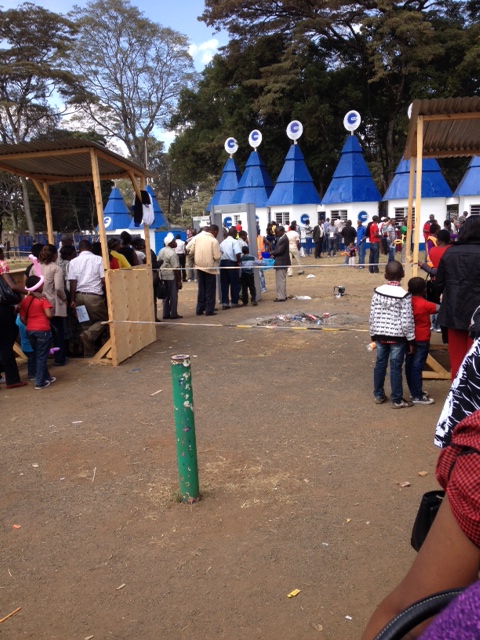
Entrance into the show, cash only

Entrance into the show, cash only

Because there were 5 of us (Liz took a day off work) we ended up splitting up into two groups.

This show is nothing like Sydney’s Easter Show. Firstly, it only goes for one week and it only costs $3 to get in.  And – lunch cost a whopping $2.50. There was a large outdoor arena where the President spoke on the day we went and there were the normal shows like bands, entertainers and marching teams. However, you had to pay another $2 for that, which we forewent. There’s also no woodchopping events, which are always great to watch.
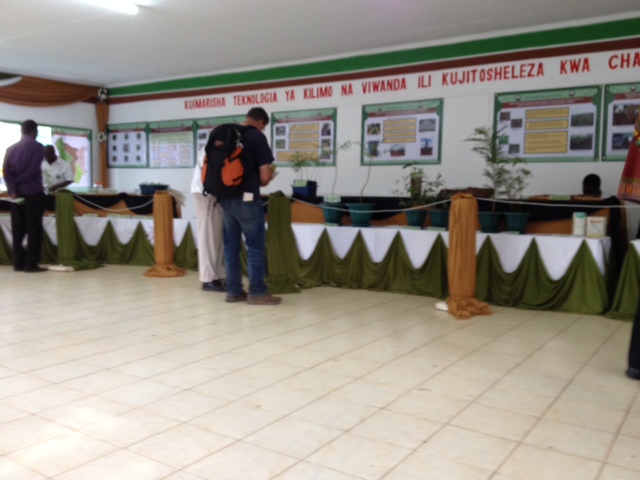
Some sites were tents, or like this one, inside a building.

Some sites were tents, or like this one, inside a building.

One thing we did notice is that there were hardly any pamphlets on offer. Every stand/tent/expo site had a guest book which you felt obliged to sign (cue endless followup calls). At some places you had to buy their handbooks ($1) but some were worth it especially on how to raise animals. Business cards seemed to be in short supply as well. At most sites there was an ‘in’ and ‘out’ sign which kept foot traffic flowing pretty well.
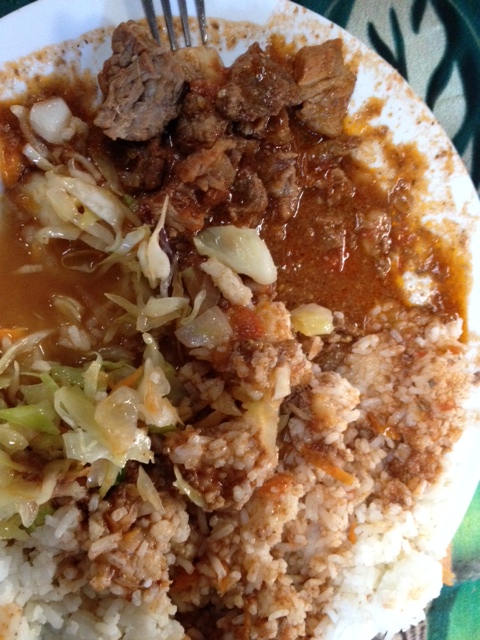
 

My $2.50 lunch - beef stew, rice and cabbage.

My $2.50 lunch – beef stew, rice and cabbage.

What wasn’t sparse was the amount of places to buy water or have your photo taken in front of a gaudy photobooth. Gaudy with a capital G. There didn’t seem to be any price hikes on drinks and food just because it was a special event, water was only 30 cents a bottle. There seemed to be endless ugly photobooths. I’m talking about large stuffed animals, Christmas decorations and weird backgrounds. Kenyans love photos and it amazed me how these were one of the hits of the show.
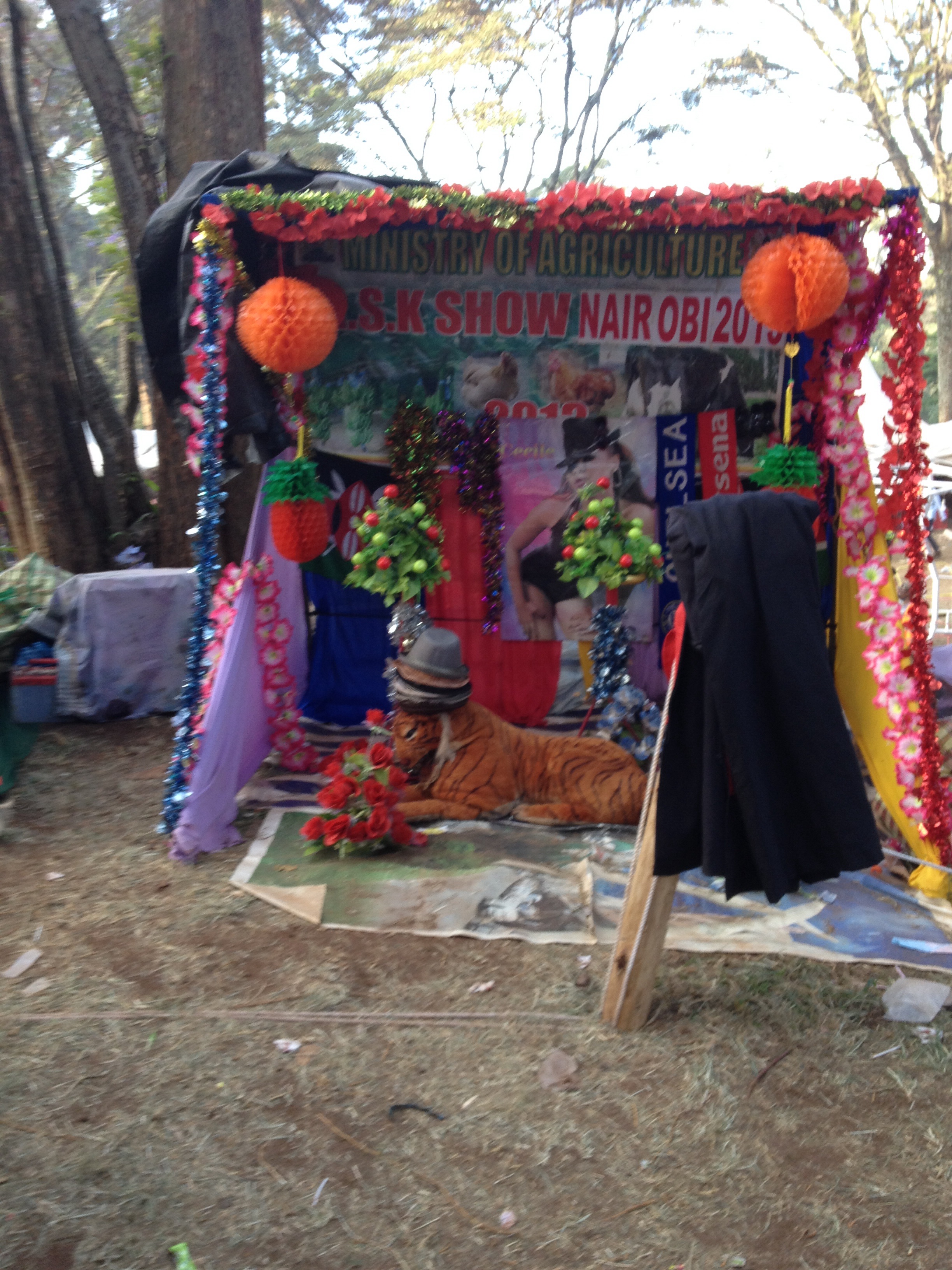
 

One of the photobooths.

One of the photobooths.

We avoided the rides and you can see why in the photo below. There were only rides that went round and round (vomit machines) and there were no safety rails. So, if you fell out, too bad. I tried to convince Liz to go on a camel ride but there was no way she was going on one of those things. Liz had a blast though and couldn’t wait to go back for a second day.
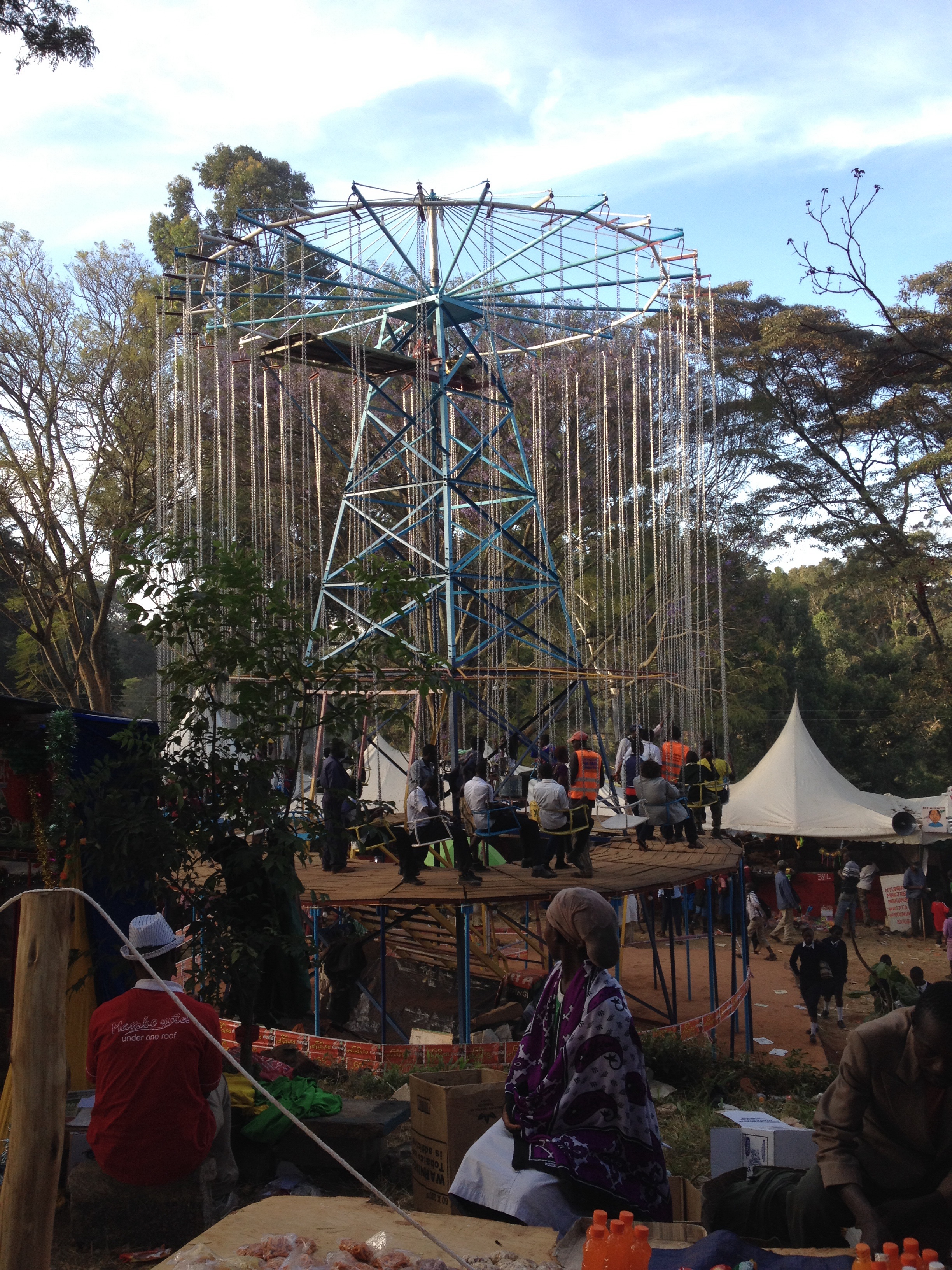
Typical ride - without safety bits on them

Typical ride – without safety bits on them

So, if you’re in Nairobi when the agricultural show is on I definitely recommend it.
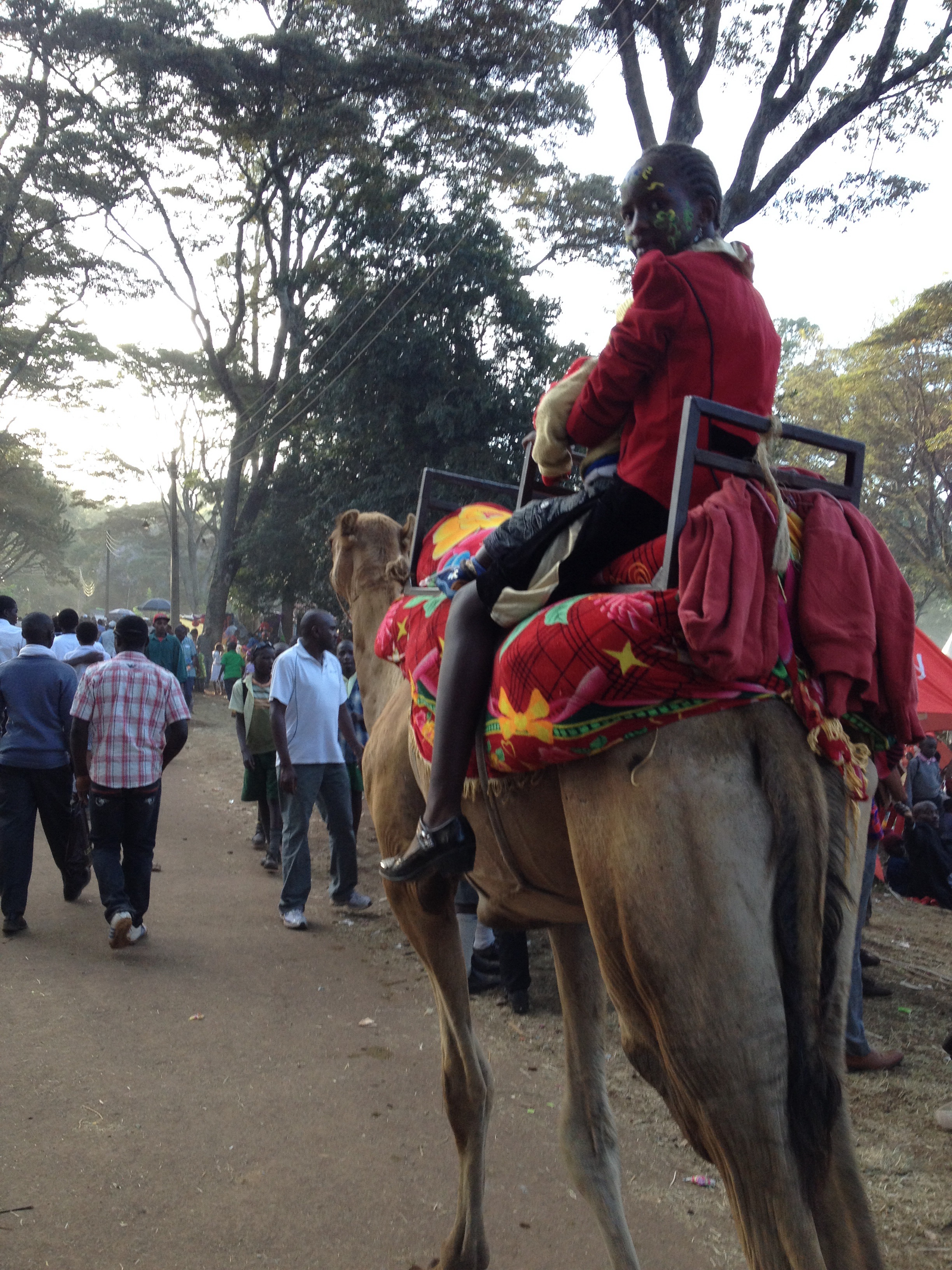
 

Couldn't get Liz on one of these

Couldn’t get Liz on one of these

Just a few things to note:

–        Go midweek, the later in the week the more people there are

–        There are ATM’s but take cash anyway

–        Be prepared to be fully checked at the entry gates for security

–        Wear comfortable shoes, a hat and sunscreen

–        There are toilets, you just have to pay 10c to use one

–        Buy a map, it’s worth it
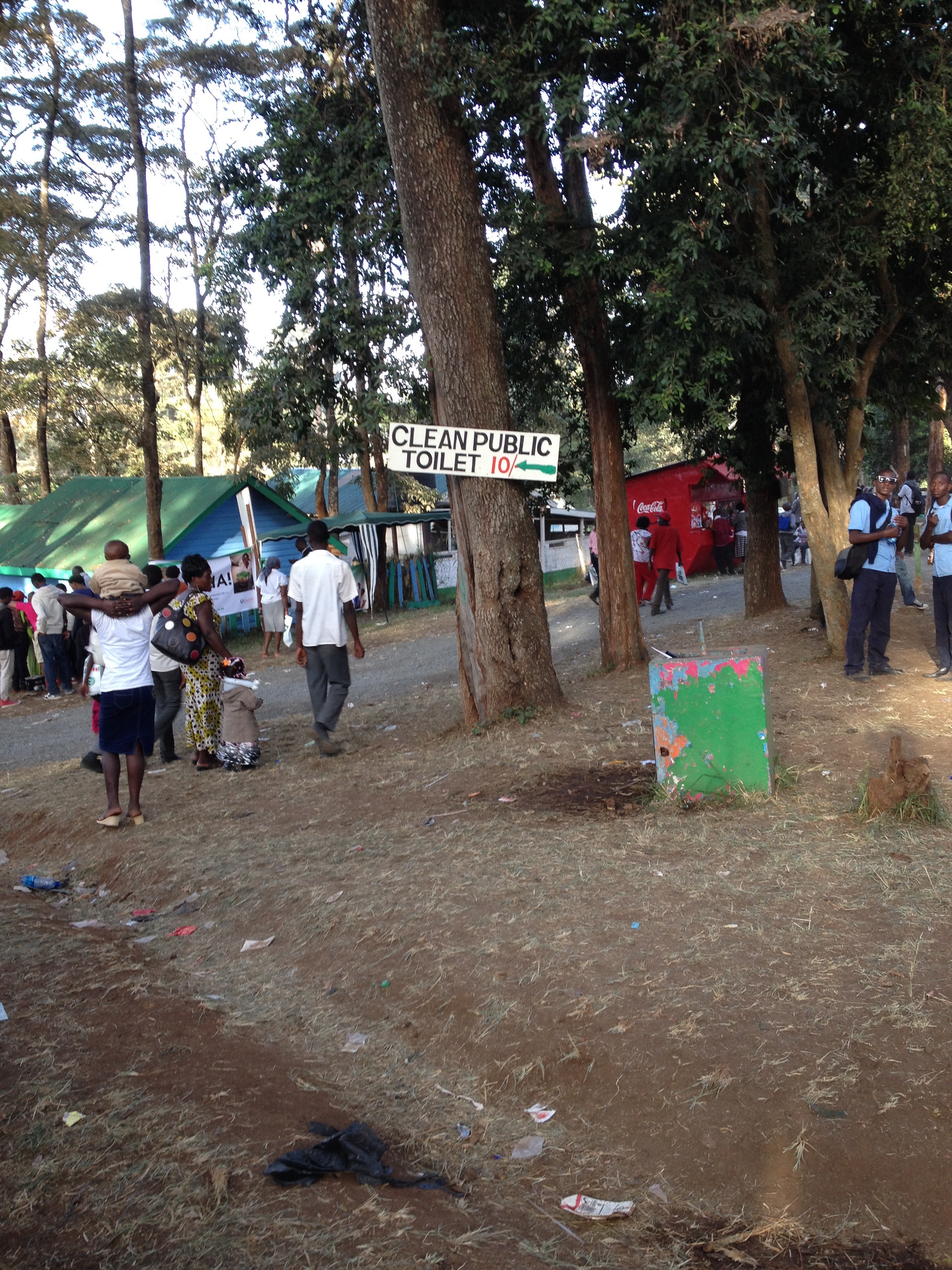
 

Take a look at the sign
Take a look at the sign


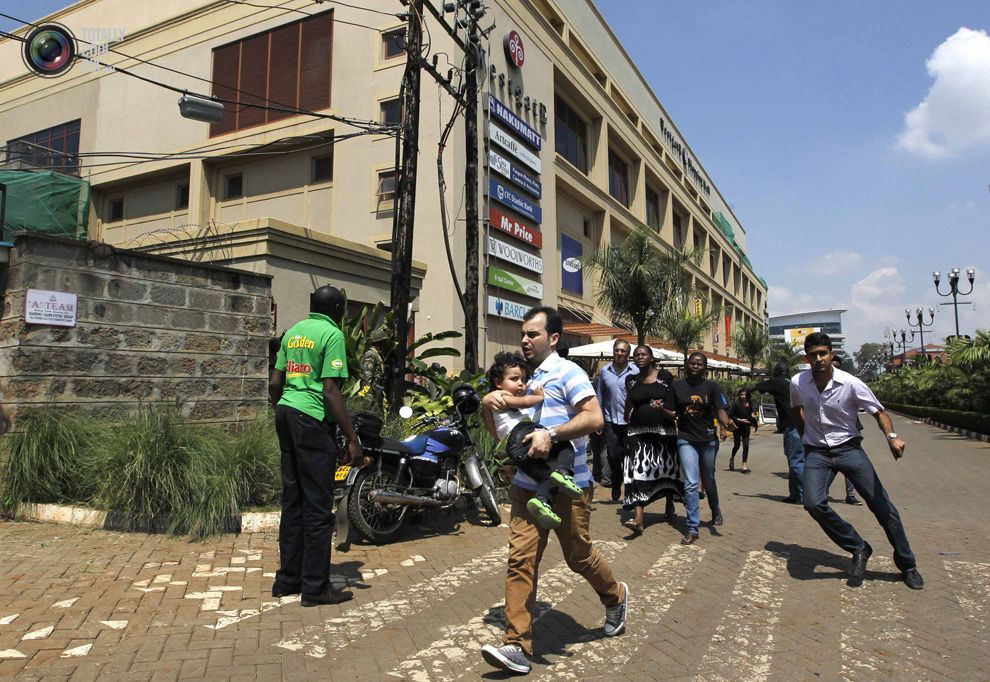
When Terrorists Strike

This weekend in many parts of the world there were terrorist attacks. To us it was brought close to home when a mall we visit was taken over by terrorists. As I write this blog it is going into it’s 4th day of the siege. Only a few minutes ago an Australian friend found out three of her close friends perished, one of them to give birth in two weeks time.

People escaping from Westgate Mall.

People escaping from Westgate Mall.

A lack of security is a reality here, but when a mall we frequent is taken over and people die it brings in a whole new level of things. Already we don’t travel at night, go for a walk at night and always lock the car when we get in it. We have a security gate on our apartment door and two night guards on the apartment block.

The thing is that you hardly ever ‘feel’ insecure. We walk through the slums (even though the Aussie High Commission says not to) to visit families and the biggest threat is shaking all of the hands of the kids who say ‘How are you?’ We are more worried about avoiding people as they step out in front of our car or suddenly seeing a donkey and cart pull out and there isn’t enough space to stop.

You get used to having your car checked at the mall, or being security scanned on the way into church. However, the thought of people attacking people as their children are in a cooking class is totally different.

The first thing that happened to us was the numerous questions on Facebook checking if we were okay. We were 4 hours away at the Amboseli National Park looking at wild elephants when I just happened to check FB to find out about the tragedy. Automatically I posted that we were fine. What I didn’t let people know is that we actually would’ve been there as already planned.

When we got back to Nairobi, like everyone else we were glued to the TV to see what the story was about. We had planned to go to the movies at the local mall, but when things like this happen you are best to stay at home. So it was toast for dinner and we put on a comedy to lighten the situation. I used this time to field through the endless questions online and SMS our pastors back home. Both responded even though it was really late, which was great. We have a number of expat friends so you instantly go through the list to make sure they weren’t near the incident. Thankfully they were all fine.

When terrorism happens people put their lives on hold. While you don’t want it to stop you from doing everyday things you can’t help yourself. You choose your seat at a café based on how you can escape. You look at people a bit more suspiciously. You decide if you really need to get a few groceries.

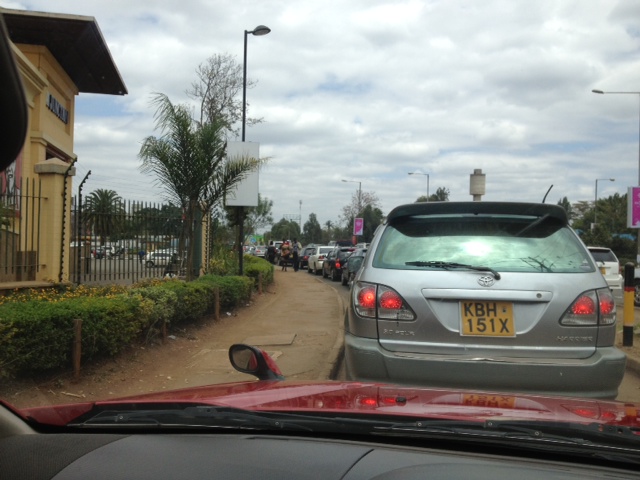
Waiting to get our car checked

Waiting to get our car checked

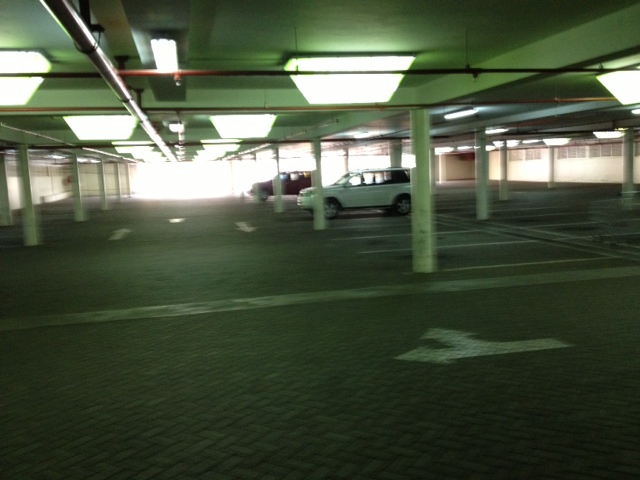
We ventured to the mall yesterday and things are very different. There is normally a check of your boot, but now they check the glove box, back seat and boot. Instead of two lines for the check, they’ve merged it into one, barriers up on both sides, and very long lines. That’s just to get into the carpark. Normally there would be plenty of cars but yesterday there were only 4 others. Javahouse is a café which is packed at lunchtime, there were two people.

At our mall you just walk in – normally. Now they are doing a full bag and body check. Pete went there on his motorbike and he had to thoroughly empty his bag out. Churches were only half full on Sunday. This is because they are normally the next target. I’m not sure if we would’ve gone had we been home.

Normally this carpark is full

Normally this carpark is full

Liz had a co-worker who was injured and like us, they started their day in prayer for our nation.

When terrorism strikes it does a couple of things. It makes people retrench and it also makes them come out and do extraordinary things. It will take a good month for businesses to recover from this incident and for those at the mall it could be a number of months. It will have a huge economic impact for those in that business district.

On the positive side people here rally in times of disaster. There was an outpouring of money, food items, counsellors and also blood donations. The Red Cross were at the forefront of this tragedy and did a great job in the face of so many challenges. It gave people a chance to go out of their comfort zones and care for others. I heard of one lady that was giving out cups of tea from the boot of her car to the police on the scene. It might not seem much but here no one does anything without payment.

Wherever we went people were glued to TV’s on updates. At our mall there were crowds of young, old, black, white trying to get a viewing point on a TV to keep updated. Some businesses closed down and had an all day of prayer. People took time out to talk to their colleagues to make sure they were okay. There were the conversations of ‘where you were when it happened’.

The Westgate Mall siege is over. The TV channels are showing less about it. People give a sigh of relief. Children return back to school and people resume their lives as normal as possible.

However, we have to create a ‘new normal’. Things won’t be the same for a very long time, especially for those involved. We will still look with suspicion and keep as secure as possible and unfortunately terrorism will happen on our back doorstep and we will go on the emotional rollercoaster all over again.

Life is not certain but our faith in God is. Stuff happens and some people equate life with God, which is not true. We live in a broken and fallen world and have to suffer the consequences of that.

What humbled us is the number of people from around the world that sent us messages of support and concern. Each and every one made a huge impact on us and wasn’t taken lightly. It reminded us that we are not here alone.

This incident also reminded me that we need to update our insurance!!


A Week With Terri

Terri (AKA Tee) is one of our many ‘extra’ kids we have in our family. We’ve known her since she was 4 years old, she is now 25. It was only a few weeks ago that she said she was coming here for 3 weeks, so we adjusted our calendar, planned some outings and finally got our guest room ready.

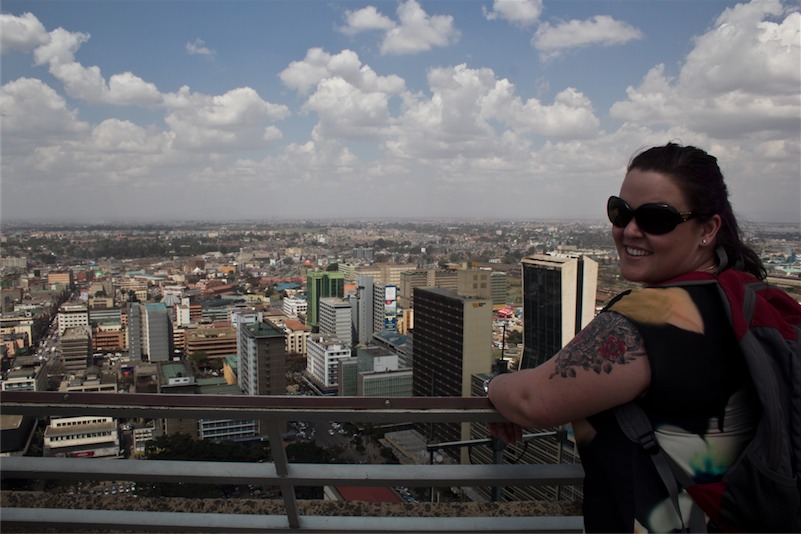
Looking out at Nairobi from the Convention Centre

Looking out at Nairobi from the Convention Centre

Until then the guest room was empty and we had always planned to furnish it, but didn’t have the funds for it. Just after we got the message that Tee was coming some New Zealand and Aussie friends gave us enough for a mattress and bed. When she arrived, another friend gave us the funds for some bedside tables. So now all we need is a BBQ, vacuum cleaner, solar backup and we are pretty much set up!

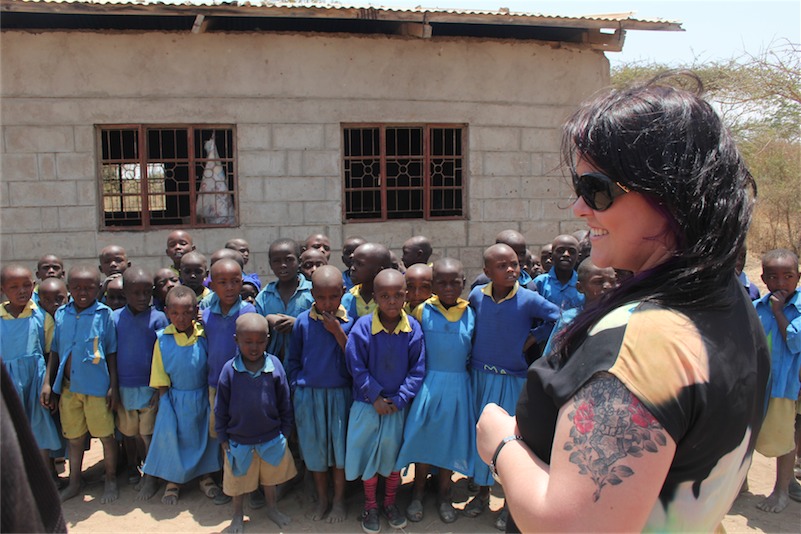
Visiting the KAG Primary School

Visiting the KAG Primary School

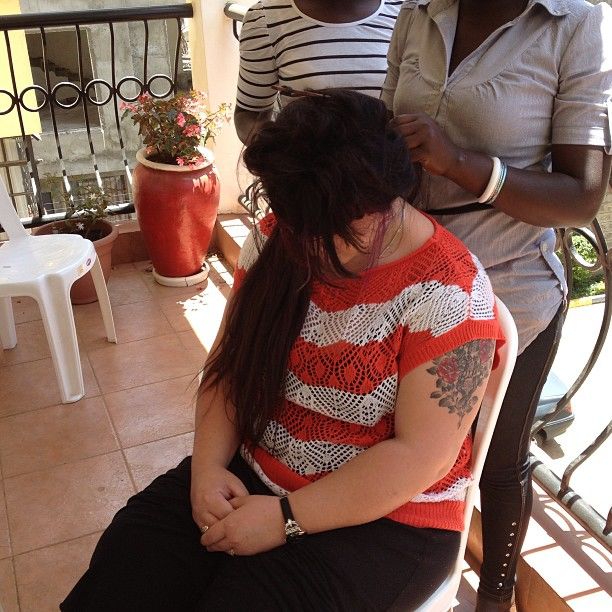
The great things about having visitors is that I get a chance to get out of the office. Not that I mind working with our team (they are the best) but endlessly looking at a computer screen gets just a bit much. So I’ve abandoned our team for the 3 weeks that Tee is here, keeping in touch online and going in only on Monday mornings. It means working at nights or sneaking in time like now when she is getting her hair braided – Kenyan style. We absolutely love having visitors and showing them that Africa is more than war, famine and poverty.

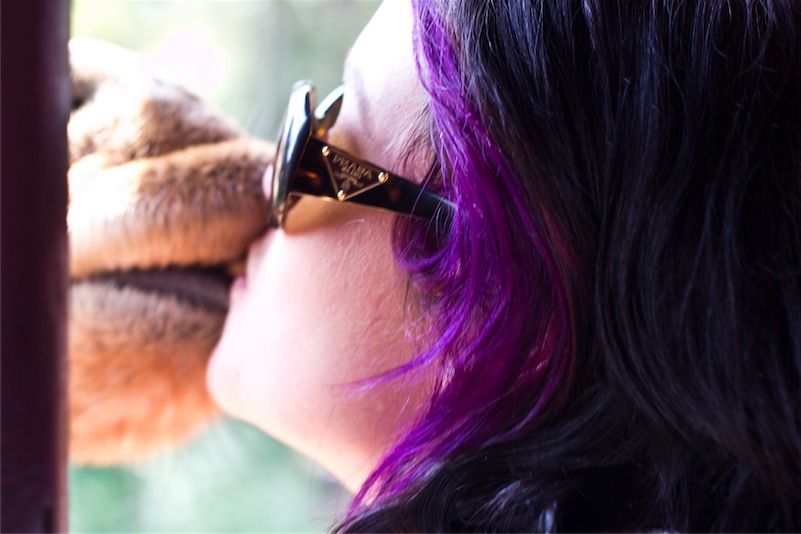
closeup kissy

This is how you kiss a giraffe

I always get amazed by what peoples reactions are to Kenya and everything it holds. Most are intrigued that we pretty much have all the modern amenities, that we drive in crazy traffic and don’t have a heart attack and how good the food is. I feel sorry for Tee because I told her that the weather had been cool, but by the time she got here it was quite warm. She came from 15 degrees in New Zealand to 25 – 27 degree heat. The other day I suggested we walk the 15 minutes to the mall – bad mistake. She has constantly reminded me and anyone we meet about how she nearly melted. Won’t be doing that one again.

Preschoolers in the Kitui District

Preschoolers in the Kitui District

The thing I love about Tee is her laugh it’s infectious. This is especially so when we’ve driven for hours and start quoting movies, Swahili practise and songs to suit the situation. That’s when we know we’re all tired and Tee’s laughs keep us going. She was only here for 2 days and we went to Kalambya in the Kitui District, around 3.5 hours from Nairobi. We left early in the morning and didn’t get back until after 9pm. It was to look at one of our new water projects but it was preceded by a 2 hour tour through a primary and secondary school. It was hot, dusty and I am sure we met everyone in the community. But, we had lots of fun along the way.

A day in the city in 26 degrees. I think they needed a coffee.

A day in the city in 26 degrees. I think they needed a coffee.

While we like to show people the touristy places we also like to show them another side of life in Kenya – where people live in poverty. We took Tee into the Kibera Slum where we were meant to take a food parcel to a needy family but their child ended up vomiting for hours and was rushed to hospital. Instead we visited some young men who are sponsored to attend school. Here we discovered that at one of their boarding schools they have to get up at 3.45am, every day! The boys were inquisitive about Tees tattoos, something happening more and more here. We also visited a school in Kibera where the little kids are so cute you want to take one home.

While you can go to some great places here, it is the people you meet who leave a lasting impression. There’s Mariam who gave us a Kenyan cooking lesson (Tee still doesn’t like ugali), Ayub and his family who came for dinner and Lucy who we took to dinner on our way back into Nairobi. Sure you can kiss a giraffe like Tee did (and who doesn’t!), feed a baby elephant or tour through a bead making factory. But it’s the incredible stories of joy and endurance that stay with you forever.

Tomorrow we take Tee to Nakuru with us to visit a school where we put down a deep bore well.  It’s only a few hours drive from here but we are staying overnight at someones house so the next day we get up at 6am to go to the national park. That afternoon we’re also out on a boat to see the animals from a water perspective.

Hair braiding takes hours.

Hair braiding takes hours.

Both Tee and Pete are big coffee drinkers. They are about half the price of what Tee would pay in New Zealand so she’s happy to stop several times at the local coffee shop. This morning I had to steer her away from Dormans, which she has come to know really well.

However, I may have to take her there later for her caffeine fix!


Food, Kenya Style

So this week I thought I’d do something totally different and let you in on our eating habits here in Kenya.  Nairobi is a modern city so we don’t have to cook goat over an open fire, although we’ve had it, and it tastes really good. Of course watching the goat get killed and sliced up isn’t so pleasant.

In Sydney we would live on BBQ’s most nights with chicken in between. To buy a BBQ here we have to pay out around $800, not a top priority but we wish it were.  Barbequed meat is much better than that done in a frying pan. When we first moved here Pete conquered a charcoal BBQ but I think our neighbours might not be so enthusiastic about the smoke, but man did the food taste good!

A frozen chicken costs about $8 and it’s pretty straight forward to throw it in the oven to roast. But I’ve learnt, thanks to Google, how to make chicken pilau. According to the locals it tastes more like a biryani (Indian) but they think it was cool that I actually tried. They must’ve liked it because three people took the leftovers home. I also like chicken pad thai but Pete’s not really a noodle fan so we can’t have it too often. He’s more of a meat and three veges guy.

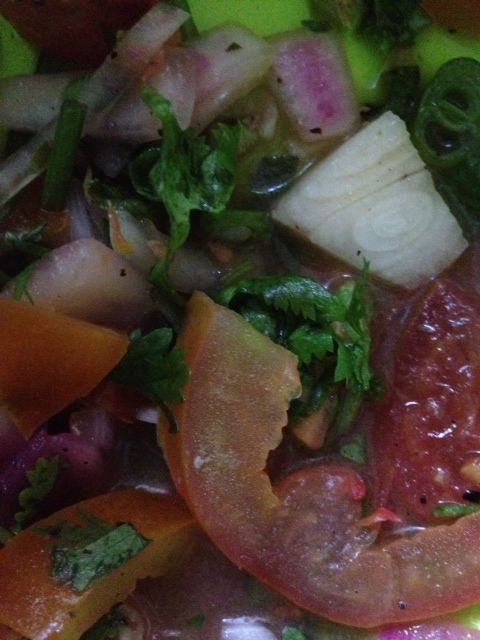
pilauI’ve also learnt how to make kachumbari. It kind of looks like bruschetta but better and you don’t have it on a slice of French stick, you can have it with anything. I found this recipe but apparently it’s not very Kenyan. Firstly you need to soak the red onion in salty water to take out the bitter taste. You’re also meant to add spring onion and white vinegar to give it a kick. Lucy, one of my co-workers made some and it was much better than mine.

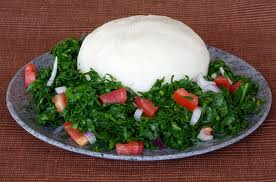
kachumbariUgali is one of our least favourite dishes. Pete refuses to eat it, that’s because he hasn’t has a good version of it. Basically it’s maize flour and water, with a touch of salt. No, it’s not a homemade recipe for glue, I’ve made that one. Ugali is a staple food here, especially if you’re in poverty. It is totally non-nutritious but here the thinking is that if you don’t go to bed with a full feeling then you haven’t eaten enough. Ugali just sits in your stomach. I got Tinga, a young man who was staying with us one weekend, to show me how he made ugali and it wasn’t half bad. Still, I only eat it when I have to.

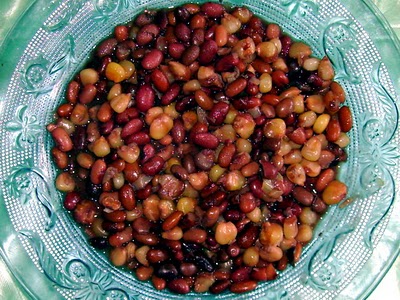
imagesGitheri is probably one of the hardest meals to handle. I’ve never had it with meat, simply with beans, maize and tomatoes. Again, Pete refuses to eat it, mainly because he needs serious dental work on his back teeth. It’s borderline okay when it’s hot but as soon as it starts to cool down it is so hard to handle. Also, my stomach reacts badly to it, to the point I can’t have it any longer.

githeriBefore coming here I never really was a coffee nor tea drinker, only when I had to. Each Thursday I go to our training facility in Kiserian (an hour away) to teach a class of boys. There we get black tea, as milk is too expensive. Here, Kenyans love their sugar. It is not unusual to have a cup of tea with 3 – 6 teaspoons of sugar in it. I’ve even got a small taste for very weak lattes. I can say I even enjoy a coffee from time to time. Mind you, at Dormans (a café) they have this delicious gluten free brownie, the only place in the whole of Kenya, which helps the attraction to coffee.

So overall, there is plenty on offer here. You can buy bananas for 5 cents each, fruit and veges are cheap, meat isn’t. There are hundreds of cafes and restaurants to choose from. Food in Nairobi is much more expensive than out of town. On Sundays after church we go to Galitos for chicken and chips. If we wanted pizza – it’s the in thing here and you can get a family size pizza on Tuesdays for $7. There’s even a place to buy frozen yoghurt – we’ve been there once with visitors who had kids, nice but so jolly expensive.

You will never starve in Africa as long as you’re not fussy. We miss real cream, cheese that has flavour and veges that you don’t have to soak in a special cleaner. But, we do have lots to choose from as you’ve seen.

One Dollar At A Time

Here in Kenya we have plenty of opportunity to help people out. There are the beggars, the disabled sitting in wheelchairs and then those selling goods at the side of the road.

There are a couple of people who have stuck out here.

One of them is a man in a wheelchair who had his legs amputated from the knees down. He sits each day at the corner by a small shopping centre. He has children (we see them from time to time) and one of the world’s biggest smiles. He’s polite and doesn’t beg for cash but you can tell he’s in need.

Unfortunately there’s no disability support pension here for people like this man. They are totally reliant on having their families support them. Every now and then when we go past his spot we drop in 100 shillings, worth about $1. More than that though, we stop for a chat and ask him how he and is family is. It gives him respect that he is of value and not simply because he needs money.

A couple of weeks ago I met the most wonderful lady. Each day she stands by the road we take to work. She is there early in the morning till it starts to get dark. She has a baby strapped to her back. She holds out her right hand for the entire time, in it she has a bag of blue sweets for sale. I don’t know how much she sells them for but probably only for a shilling or two. I don’t know this lady’s name but I really admire her.

On either side of her stand men selling DVD’s, posters, flowers and the matatus (vans moving masses of people) and buses throwing out diesel fumes.

I admire her because she’s not waiting for her situation to change, she is changing her situation, one shilling at a time.

I am more than happy once a week to drop 100 shillings into her hand. I usually ask for a couple of sweets so it doesn’t look like I do it out of pity. No, I do it in admiration.

You might say that it’s only the odd dollar, what difference can it make? But to these 2 people it means they can buy some flour and make ugali that night. It means that they have something to put towards their rent. Or it may mean they can afford to buy one jerry can of water.

Even though our personal support level is short by about $1,000 per month, I’m not going to let it stop me being generous. These two people inspire me to keep going even when it all seems a bit much.

My next step is to get to know their names.

Tell me about someone who has inspired you lately.

Hunting For Beads

So, I come up with this idea for our child sponsorship program and that is to get the kids to make a small gift for their sponsor. I was thinking of a bead bracelet of really nice handmade card. So now we have to find the materials.

Forget your local arts and crafts shop, think more like – it’s bigger than Ben Hur.

I know I will get ripped off because I’m a Mzungu (whitey) so I take my partner in crime and co-worker Joy with me.

my view from inside the matatu

my view from inside the matatu

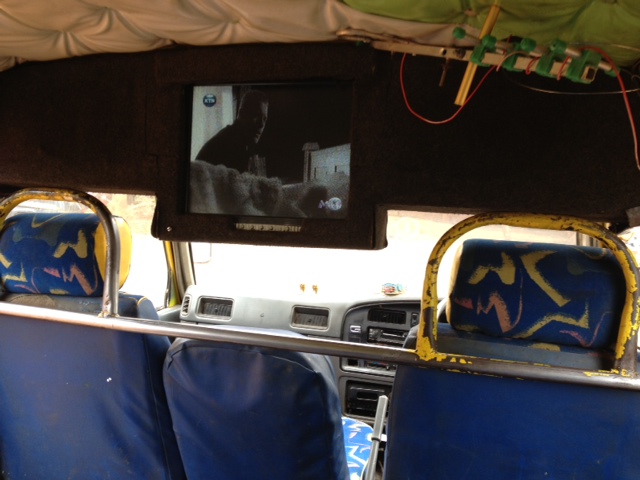
Step one – get a matatu into town, but first you have to wait for it to fill up. We only waited for about 15 minutes so that’s pretty good.

Step two – walk for 5 hours around town visiting various touristy stores to see what they have on offer as well as several markets to see if we can bargain for a better price.

Our overall goal was to get some ideas for cards using local material to spruce them up and see where the beads come from.

This is Joy after 2 hours

This is Joy after 2 hours

At the Masai market (there’s stacks of them) no one was giving away their secrets, they just wanted us to buy something. I’m teaching some of our students on earth sciences and spotted a piece of pumice for around $1.50 which I thought was good. No way was Joy letting me spend that much, she reckons it’s only worth around 50c. No matter what I said she refused to let me buy it and said that I could get it for the same price at the local supermarket. For 2 days now I’ve looked at every shopping centre in the area and there is no pumice in sight. Hence as I am writing this Joy is going back into town to buy me a piece of pumice so I can talk to the students on volcanic rocks.

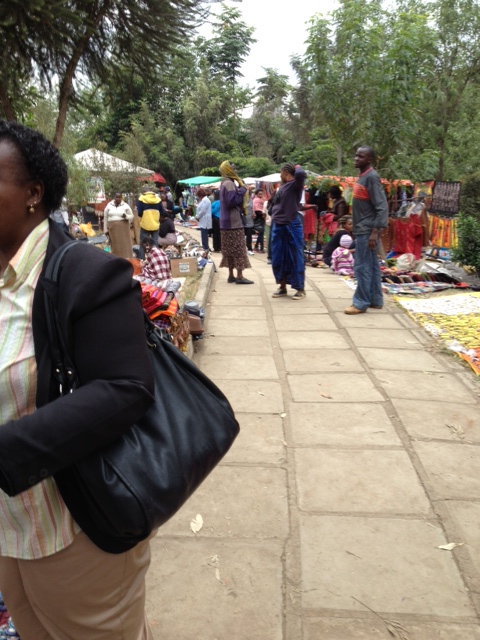
There are both locals and tourists at the market

There are both locals and tourists at the market

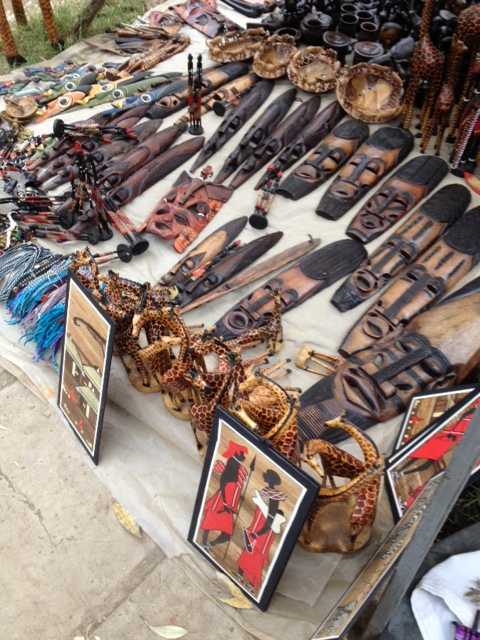
I’m glad I didn’t have much cash on me because there are some very cool things at these markets. You’ll see people making necklaces, carvings and trinkets. You didn’t get hassled like in other markets. It was quite relaced and orderly. Except there was one vendor who thought I was telling lies when I said I’d been here for 9 months because my skin wasn’t dark enough!

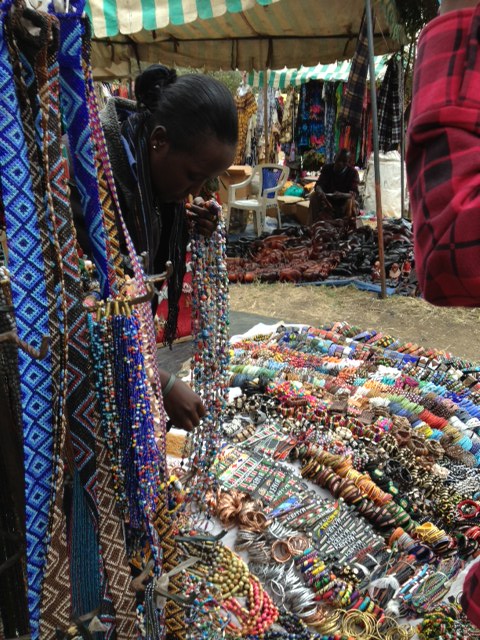
What we discovered in the end is that you can’t buy just plain white cards, you have to cut your own. Everyone at the markets buys their beads from some invisible person first thing in the morning, pulls apart the necklaces and then put them back together in a special design by the vendor.

Some of the very cool things for sale at the markets

Some of the very cool things for sale at the markets

After traipsing around for hours we headed to a bookstore in search of a book on volcanoes and what did we find – a bead shop. However we had to wait until 2pm because all the shops closed between 1 and 2 for lunch. When it did eventually opened we discovered a little Masai woman in their buying her beads to take back to the markets to sell. So this was their secret spot.

By 2.30pm we were absolutely starving and managed to find the one and only place to get something to eat in the whole of the area. I guess this is where everyone went for their lunch break while we meandered around the market. Beef stew, rice and a bottle of soda all for $5.

Bargaing necklaces down from $1.50 to $1. In the end we paid $1.30

Bargaining necklaces down from $1.50 to $1. In the end we paid $1.30

Of course as soon as we got back to the office (another matatu ride for 40c) someone announced that they knew of a place 2 hours drive from Nairobi that you can buy beads from.

Guess where my next adventure will be!

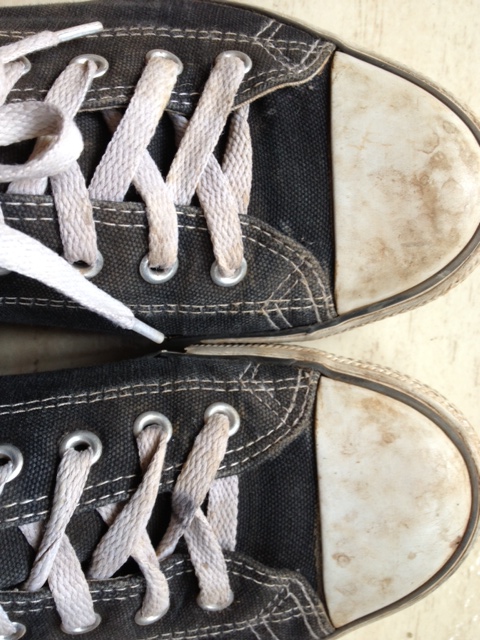
Always have a good pair of sneakers for the long walk ahead

Always have a good pair of sneakers for the long walk ahead


How to Ride a Piki Piki

Actually I like the use of the word boda boda better. It’s the name we give to motorbikes that are used in the same manner as a taxi.

Boda boda originated at the border (hence shortened to boda) of Kenya and Uganda. With the drop in the price of the Chinese made motorbikes, there are plenty available.

I catch bikes every now and then and love it. Most expats freak out at the thought of catching a motorbike in Africa. Liz catches one to work each day. They are so cheap to go on you just can’t say no. For only $1 you can go a few kilometres which is about a quarter of the price of a car.

I was watching a Kenyan doco and the presenter said “Anybody who rides a piki piki takes their life into their own hands.  And they are correct!

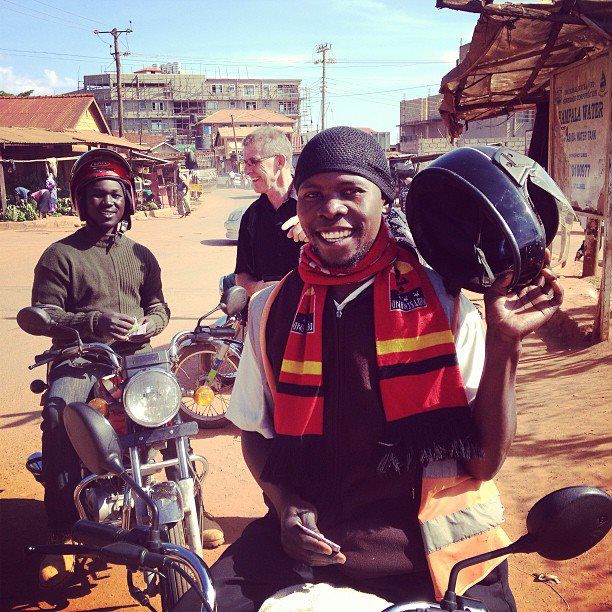
Our boda drivers in Uganda

Our boda drivers in Uganda

Thanks to our generous friends we bought our own motorbike but we made sure that we also bought high vis gear (think bright orange council jackets). Drivers are shockers here. Today I was walking on the footpath and the next minute a large bus decided it wanted to share it with me.  While we are waiting to buy a car, I catch a piki piki when Pete has the car. This year I aim to get my motorbike license.

On our last trip to Uganda Pete and I went on bodas (they shorten it in Uganda) everywhere. One of our longest trips was about 30 minutes. Kampala traffic is twice as congested as Nairobi, hard to believe but true.

There are some tricks to catching a piki piki though:

  1. Always negotiate a price beforehand.
  2. Have cash in your pocket. Getting your wallet out is a bad idea and too tempting for the price to be raised.
  3. Ask for a helmet. You can’t grow another head (although I must confess that I am bad at insisting on this).
  4. Give instructions as you go along with your hands. There seems to be more ‘lefts’ than you think.
  5. Always be on the lookout for a jump off spot. You just never know when you might need it.
  6. Get off the bike before you pay the driver.
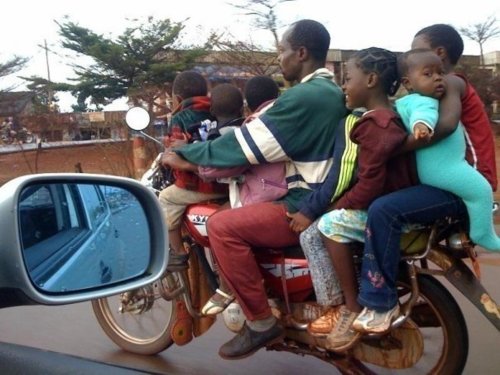
This is illegal, but it still happens

This is illegal, but it still happens


Dating, Marriage, Sex

This week we had an interesting conversation in the office and that was to do with how girls and guys date, what’s expected and what the general norm is.

It all started out when I shared about how in our family there’s a certain way we do things:

1. No boyfriends before 18

This went down like a lead balloon. Kids are too much in a hurry to grow up. They need to enjoy some of the most challenging years of their lives without the complication of ‘going out’. We always told our girls that you don’t have to be attached at the hip of a guy to be someone.


2. The guy asks permission to ‘court’ our daughter

We don’t believe in the try and buy scenario of dating. A relationship with the potential new family member is really important and if they respect you enough to ask permission, then they hopefully will respect your best investment – your child.


3. If one of our girls are in another town or country (as what we have now) they have to be sussed out and approved by a family member.

In line with our Pacific Island upbringing, Aunty is a pretty powerful person in the family. In New Zealand we have a cousin who has ‘Aunty’ status who keeps an eye on things. In Australia we had a friend who was an ex SAS member and he (okay he was a guy but you get the drift) would ask the hard questions on our behalf, it was great. I am sure they were scared of Jeff!


4. As a couple who profess to the Christian faith, they are encouraged to meet with their pastors and be accountable to them.

It takes a brave couple to tell their pastors that they are going to the next level in their friendship because it gives the pastors authority to speak into their lives and they may not like what they hear.


5. The couple set boundaries to keep themselves out of situations they may regret.

If it really doesn’t go anywhere, they can remain friends and still look each other in the eye.


6. Both parties take their ‘friend’ to their families homes.

This means involved in family activities such as dinners, going out to movies, church and special events. When you marry someone, you marry into their family as well.

Of course it all has to be in context. We have always encouraged our girls to make friends both boys and girls and if they are to go out, do it in a group.

We’ve openly talked about sex since they were 9 &10 years old (they’re 22 & 23 now) – in an appropriate manner of course. Both our parents never talked about ‘the birds and the bees’ so we decided to, bringing in a Biblical viewpoint. They were homeschooled till they were around 11 & 12 and then put into a public system when we moved to Australia.

We’ve always made a point of being involved in our girls lives. Even now we take them out of dates and a good catch up time. While we never had a lot materially we made this investment. When Hannah had finished secondary school we insisted that the whole family go on a two month tour of East Africa. At first she wasn’t happy about it (insisting she wanted to work, I pointed out that she had the rest of her life to work), but it changed her world forever. Both of our girls are global travellers and have experienced many cultures, which has broadened their personal worlds.

heartHere in Kenya I’ve discovered things are quite different.

  1. The only time the family sees the new ‘friend’ is just before the engagement happens.
  2. If the parents don’t like the potential addition to the family and the girl really wants him, she has to choose between her family or his if things get really bad.
  3. When the two families meet they sit formally opposite each other. This is when the dowry is discussed. It goes through stages of friends who can vouch for you (at the serious stage), then the uncles go.
  4. Parents don’t talk to their kids about sex. That happens in school (apparently).
  5. If a girl gets pregnant out of wedlock, she will most likely be beaten badly and kicked out of home. Some parents are more supportive but the guy involved has to front up to them.
  6. If you’re not married by your late 20’s you’re over the hill.

Of course, within the Kenyan culture there are lots of ways of doing things but above is what has been a long held tradition. I have a Kenyan friend who said when she got pregnant her mother accepted her and supported her.

I have another one who is not allowed to get married to the father of her child, but they can live together, because they don’t have the money for a huge wedding (the father knows some high ranking people who HAVE to be invited). When they go to her family in the country her partner is not allowed to sleep in the same house as everyone else.

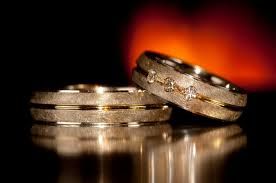
ringsEven if my girls were raised in Africa, I still would keep to how we as a family do things.

As our kids grow into adulthood they have to make their own choices and live with the consequences. As a parent all you can do is your best and support your kids in the same manner.

So:

–        Do you talk to your kids about dating, sex, relationships or leave it up to others (school, friends, social media)?

–        When was the last time you took one of your kids out on a date by themselves, just for the sake of it?

–        What values do you hold as a family?

–        What memories are you building that your kids will take into adulthood?

This Might Offend You

Why on earth would anyone in their right mind title their post about offending someone? It’s because what you see below might not go with your theology or world view. I hope it gets you to a point of asking yourself ‘why do I believe what I believe and why do I do what I do?’

1. I try to never to call myself a missionary

The only exception is when I’m getting ripped off by a local and I say “Look I don’t work for the UN, I’m just an Australian missionary” then they understand that I really don’t have much.  As far as I am concerned I’m an ‘international development worker’. I believe everyone of the Christian faith is a missionary. One of the best things I learned under our pastor from Sydney is that we are to be ministers in the marketplace. We are all ‘sent out for a purpose’. Sure it might not be behind a pulpit, it may to be a business person, parent, police officer or office worker. It’s about being the salt and light to the world. It doesn’t matter if I’m hanging with some high member of government or a mama in a slum. We are all in need of a relationship with Jesus. I cringe when people say ‘Oh, you’re a missionary’. It reminds me of the long skirted, bi-spectacled, bun wearing elderly nun that people have in their minds. Me, I wear tight jeans, a lot of black and even sometimes listen to rap music (cue Toby Mac).

2. Lying is still lying

People call it a ‘white lie’, ‘making it easier to go down’ or ‘that’s the culture of the place’. If it’s not the truth, it’s a lie. If you say you’re going to do it, then do it. I learned this the hard way a very long time ago. Their was a friend who when I said I must come for a visit replied ‘you always say that but it never happens’. She was right and I felt gutted. I don’t care what country you’re in, if you say ‘yes’ then let it mean yes. Sure, theres cultural things like turning up on time, which can be relevant  SEE HERE but let’s get honest about honesty.

3. I refuse to think small or backwards

I’ve lived a lot of my life with feelings of insignificance and not in a small way either. I remember when I was much younger in the early days of marriage. Pete and I would go to pastors conferences and I was so overwhelmed by insecurity that I would say to him “Don’t you dare let go of my hand”, simply because I didn’t know anyone. Sure, getting up in front of hundreds of people was no problem, but in a one on one situation I was so uncomfortable. Mind you, walking into a pub was so foreign to me and I felt so uncomfortable that I couldn’t wait to get out of there. While I still abhor pubs (with the stench of beer which I hate) I am now very comfortable meeting total strangers. I would hate to go backwards and to what I was.

I also despise thinking small. I’m always trying to find more innovative ways of doing things. It makes people who’ve ‘always done it this way’ very uncomfortable.

To do the same thing over and over and expect a different result is a sign of insanity (Albert Einstein).

In the words of the Matrix ‘there is no box’.

Instead of limiting ourselves by our personal skills, resources and money, why don’t we think like God and ‘do it anyway’. Quite frankly, there will always be people who are better than you, have more degrees than you and way more money. So what? Does that mean we sit in a corner sucking our thumbs and going ‘woe is me’. Forget what you don’t have and look at what you do have.

I have enough regrets in my life, I’m trying to add as few as possible to that list.

4.  I’m not the handbag type

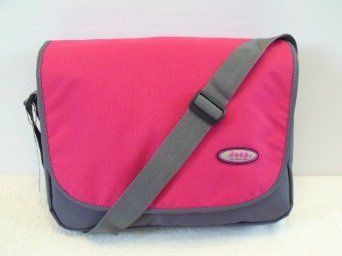
Someone in the office asked me the other day if I actually owned a handbag. You might think that was a random question, but a valid one. That’s because I normally have an orange bag made by Jeep, one that slings over your shoulder. It is really handy because it has some good hidden pockets (much needed in Kenya), is washable and I can wear it over my shoulder and in the front of me. I originally bought it for our 2011 trip to Africa. It has been my constant companion wherever I go.

A close friend of mine, Ros told me once that I had the ‘classic look’. I’m not into flowery dresses but plain colours, wear Converse more than heels and shock the office staff when I wear dangly earrings. Sure, I can dress up with the best of them when I have to but mostly wear jeans and a hoody, simply because it’s comfortable. Right now I’m sitting in an office with my feet up on a drawer with my headphones on. There’s no rhyme or reason, just that it’s good for working in.

What it comes down to is be who you are created to be. Stop trying to be a people pleaser. You can only please some of the people some of the time.

bag

My bag is a burnt orange and not pink – I dislike pink.

5. I believe in an even playing field

Out of everything written this is probably the one that will offend people the most. I don’t care what colour, gender, age, nationality, tribe or at what income level someone is. We all label people. In Australia you would say ‘You can’t trust a P plater’, that was someone on a provisional driving license. Here, it is said “That’s because they’re a (fill in the tribe)”. Sure, certain ethnicities exhibit predominant behaviours, but why do we label a whole people group with the same paintbrush? There’s a generation gap because we formed it. There are divisions, racial hatred and animosity between rich and poor. I’ve had the privilege of sitting with a homeless person in Sydney right in Martin Place and ask them their story. Sure it was great to buy them some sandwiches and drink, but it was more important to sit and just talk with them. I’ve also had a cup of tea at the Governor General’s house in Kirribilli. It makes no difference to me if I’m working with locals in Hawaii or Kenya. I don’t distrust someone because of their skin colour or the language they speak. Over the past 8 months I’ve met some incredible people and others I wouldn’t trust as far as I could throw them. And there are lots of different nationalities here.

At the end of the day we all bleed red.

Thank you, thank you very much (Elvis)

In October last year Pete, Liz and I left our home, our family and friends and our youngest daughter to move to Nairobi, Kenya.

Note that I said moved and not just to visit.

There is a huge difference from going somewhere for a couple of months each year to actually packing up and relocating. Sure, people will put up with your habits, idiosyncrasies and weird ways of doing things. Give it 6 months and they may want to quit before you do!

There are days when it is really satisfying, especially when you can help one of the local leaders do their job better, or when a teenager who never talks to you comes up and says ‘Thanks, keep on doing what you’re doing, it’s great’. Other days suck to the max.

You get over every second guy on the street yelling out ‘Muzungu’ (yes I do actually know that I’m white but thanks for pointing it out anyway). Or the traffic is so bad it makes you want to beg the next driver to do you a favour and run you over. Or you just want to be with old friends but know that YOU’VE made the choice to leave them.

Moving country, especially to a developing one, is not for the faint hearted. I think I’ve discovered more about myself than anything else in the 7 months we’ve been in Kenya. I don’t always like what I see, but I hope it’s a passing phase.

Sometimes we just want to escape Nairobi and get away from it all. We do that by going to look at potential water projects out of town. That may mean driving to another country but it’s worth it. Personally, I’m looking forward to going to Tanzania later in the year. It’s only about a 5 hour drive (okay, add another hour at the border) but that’s nothing. We’ve a number of friends there doing stuff like schools and training programs and I think I’m going to enjoy just being with them for a few days.

While you can’t always escape a situation, you can always do something really out there. For me, it means having a latte. Sure, you can mock, but I’ve never been into coffee so to go and actually pay for one and drink it is a huge thing. Pete and I have found it a way of doing cheap therapy. Mind you, there’s this really nice gluten free brownie that is phenomenal.

Amongst it all, I am truly grateful for what we have right now. We have electricity, which is a bonus, especially since it’s been off for most of the last 3 days. Today, we got curtains for two of the bedrooms. It’s got to beat having a blanket up there. Last week, a very generous business offered us the funds for a car – that is absolutely huge. I love it when I get Facebook messages, text messages or emails from people to let me know they haven’t forgotten we exist.

Thankfulness is a real key to being in a place like Africa. You get to rejoice in the little things – like having access to a flushing toilet or a car that someone lends you. But it’s also being thankful when things don’t go your way. The Bible says to give thanks IN everything, not necessarily for it. I’m not overjoyed when I know that some of the kids in the child sponsorship program are struggling with alcoholic parents, aren’t making it in school or may be married off in their mid teens. But I am thankful that they can actually go to school and get a chance to make their future different.

So, I can sit and whinge that there’s no electricity to cook Pete a nice roast meal, or I can get over myself and get the gas going and put it in a frying pan.

thanks

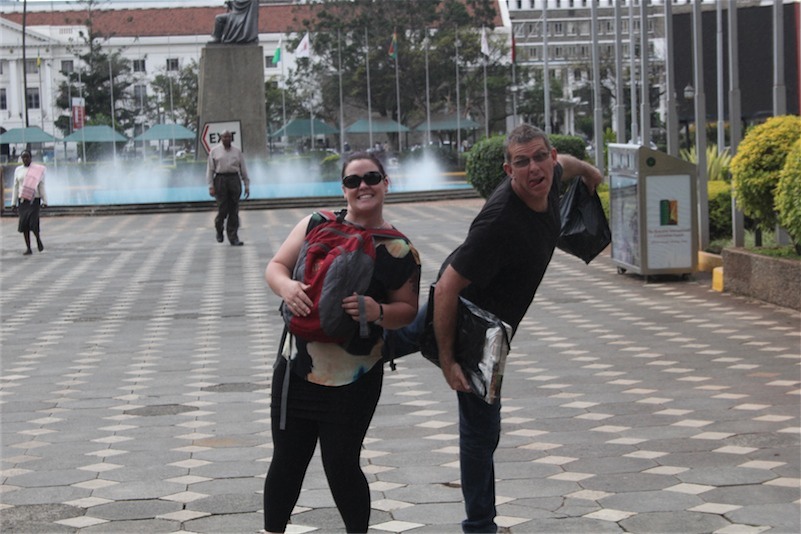
Yes, this is sometimes us.